
In the previous article, we discussed how the body’s physiological response to circulatory compromise can make a patient with sepsis appear deceptively well during the compensatory stage.
The key message was simple: do not be falsely reassured by how the patient looks. Instead, pay close attention to the vital signs and interpret them together with the overall clinical picture.
Once sepsis is suspected, however, another important question follows:
What should I do next?
This article focuses on screening for sepsis and the immediate life-saving interventions that should follow.
Screening for Sepsis
Early recognition remains the cornerstone of sepsis management.
Screening tools such as the National Early Warning Score (NEWS) are recommended to help identify patients at risk of clinical deterioration. They provide an objective assessment of physiological abnormalities and can prompt earlier recognition of sepsis.
However, no screening tool is perfect. Current evidence supporting NEWS in sepsis detection is of moderate certainty, and it should therefore support—not replace—clinical judgement.
Patients should always be assessed holistically, taking into account the history, source of infection, examination findings, and trends in vital signs.
Once a patient is identified as having suspected sepsis, confirmed sepsis, or septic shock, immediate treatment should begin. Do not wait for further deterioration before acting.
The Sepsis Bundle – Understanding the “Why” Behind Each Step
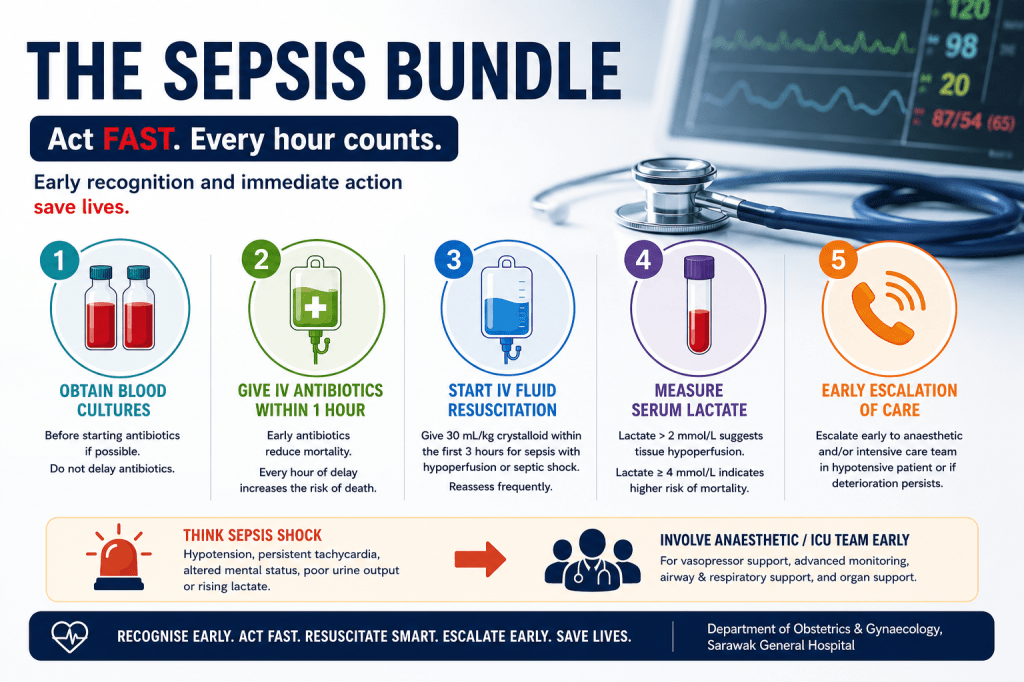
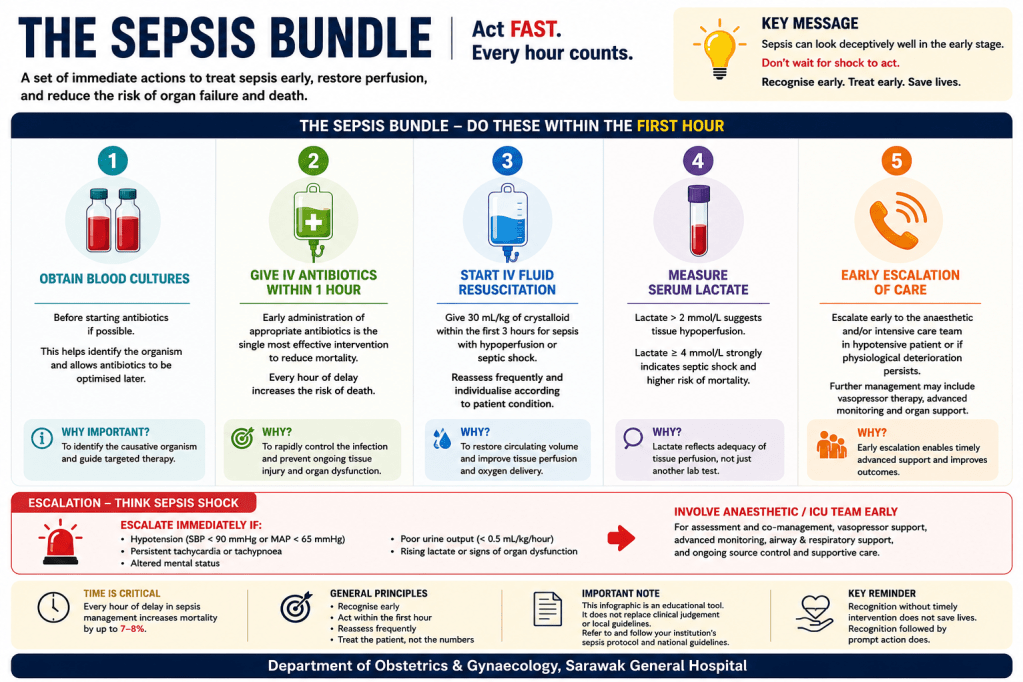
The Sepsis Bundle is much more than a checklist. Each intervention targets a different aspect of sepsis pathophysiology. Understanding why each step is performed allows clinicians to appreciate its importance and apply it promptly.
1. Obtain Blood Cultures
Whenever feasible, obtain blood cultures before commencing antibiotics.
Blood cultures increase the likelihood of identifying the causative organism and allow subsequent optimisation of antimicrobial therapy.
However, blood cultures should never delay antibiotic administration.
Why?
Early identification of the responsible pathogen allows antibiotic therapy to be refined, reducing unnecessary broad-spectrum antibiotic exposure while improving treatment effectiveness.
2. Administer Intravenous Antibiotics Within One Hour
Early administration of appropriate antibiotics is one of the most effective interventions for reducing mortality in sepsis.
Every hour of unnecessary delay allows bacterial proliferation, ongoing tissue injury, and progression towards organ dysfunction.
Why?
Eliminating the source of infection early interrupts the inflammatory cascade before irreversible organ damage develops.
3. Begin Fluid Resuscitation
Patients with sepsis frequently develop intravascular volume depletion and impaired tissue perfusion.
Current recommendations suggest an initial crystalloid infusion of 30 mL/kg within the first three hours for patients with sepsis-induced hypoperfusion or septic shock.
However, fluid therapy should not follow a one-size-fits-all approach. Patients should be reassessed regularly, taking into account pregnancy, age, cardiac function, renal function, and their clinical response.
Over-resuscitation can be harmful and may result in complications such as pulmonary oedema.
Why?
Adequate intravascular volume is essential to restore tissue perfusion and oxygen delivery, but excessive fluid can itself contribute to morbidity.
4. Measure Serum Lactate
Serum lactate is an important marker of tissue hypoperfusion.
A lactate level greater than 2 mmol/L should prompt careful reassessment and optimisation of resuscitation.
A lactate level ≥4 mmol/L identifies patients at particularly high risk of septic shock and mortality, requiring urgent escalation of care.
Why?
Lactate reflects the adequacy of tissue perfusion. An elevated lactate may indicate that tissues are not receiving sufficient oxygen even when the blood pressure appears normal.
5. Early Escalation of Care
Patients who are hypotensive or continue to show evidence of physiological deterioration should be escalated early to the anaesthetic and/or intensive care team.
Further management may include advanced haemodynamic monitoring, vasopressor therapy, airway support, and other organ support as required.
Why?
Advanced supportive therapies are time-sensitive. Early involvement of the anaesthetic and intensive care teams facilitates timely initiation of vasopressors, invasive monitoring, and organ support before irreversible deterioration occurs.
Practice Point
Do not delay escalation while waiting to see if the patient responds to initial treatment. Early escalation saves valuable time, and in sepsis, time saves lives.
Practice Reflection
Recognising sepsis is only the first step.
Recognition without timely intervention does not save lives. Recognition followed by prompt action does.
Final Takeaway
The Sepsis Bundle is not simply a checklist.
Each component addresses a different aspect of sepsis physiology. Understanding the rationale behind every intervention enables clinicians not only to remember the bundle, but also to appreciate why every minute counts in the management of sepsis.
Next in This Mini-Series
In the next article, we will explore serum lactate in greater detail.
We will discuss what lactate represents physiologically, how to interpret different lactate levels, its role in identifying tissue hypoperfusion, and its limitations in clinical practice.
Understanding lactate is essential because it is much more than just another blood test—it is a window into tissue perfusion and the adequacy of resuscitation.
Important Note
This article is intended as an educational discussion to support understanding of the physiological principles behind the recognition and early management of sepsis. It is not intended to replace local, national, or institutional clinical guidelines. Clinicians should always refer to the latest evidence-based guidelines and follow their local sepsis protocols when assessing and managing patients.
Continue the Conversation
The Refining Our Practice series aims to support practical refinements in everyday clinical practice across hospitals, health clinics, and Maternal & Child Health Clinics.
Future topic suggestions, feedback, and clinical questions are always welcome.
Written by
Dr Nurulhuda Samsudin
Obstetrician & Gynaecologist
Sarawak General Hospital
 Department of Obstetrics & Gynaecology, Sarawak General Hospital
Leave a comment