
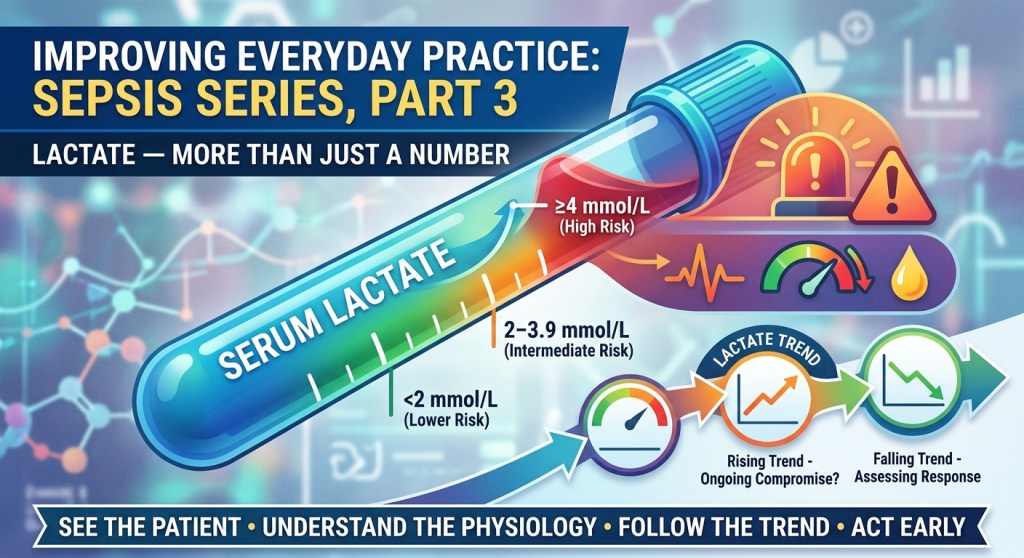
We have discussed recognising sepsis, identifying deterioration and acting early. In this final part of our sepsis mini-series, we focus on one important physiological marker: serum lactate.
Lactate is more than another blood-test result. When interpreted in the right clinical context, it can help us recognise physiological compromise, assess severity of illness and identify patients at increased risk of adverse outcomes.
Why does lactate matter?
Lactate can rise when tissue oxygen delivery is inadequate relative to metabolic demand. In sepsis, however, increased lactate can also result from adrenergic stimulation, altered cellular metabolism and impaired clearance.
A raised lactate does not automatically mean shock, but it should never be dismissed without assessment.
The patient who looks well
A patient with sepsis can maintain an apparently normal blood pressure despite significant physiological disturbance. Initially, compensatory mechanisms help maintain circulation, even while tissue perfusion may be compromised.
The patient may be conscious, talking and seemingly comfortable.
Normal blood pressure does not necessarily mean adequate tissue perfusion.
A significantly elevated lactate in a patient with suspected sepsis should therefore prompt urgent reassessment, even when the patient does not look critically ill.
Lactate and mortality risk
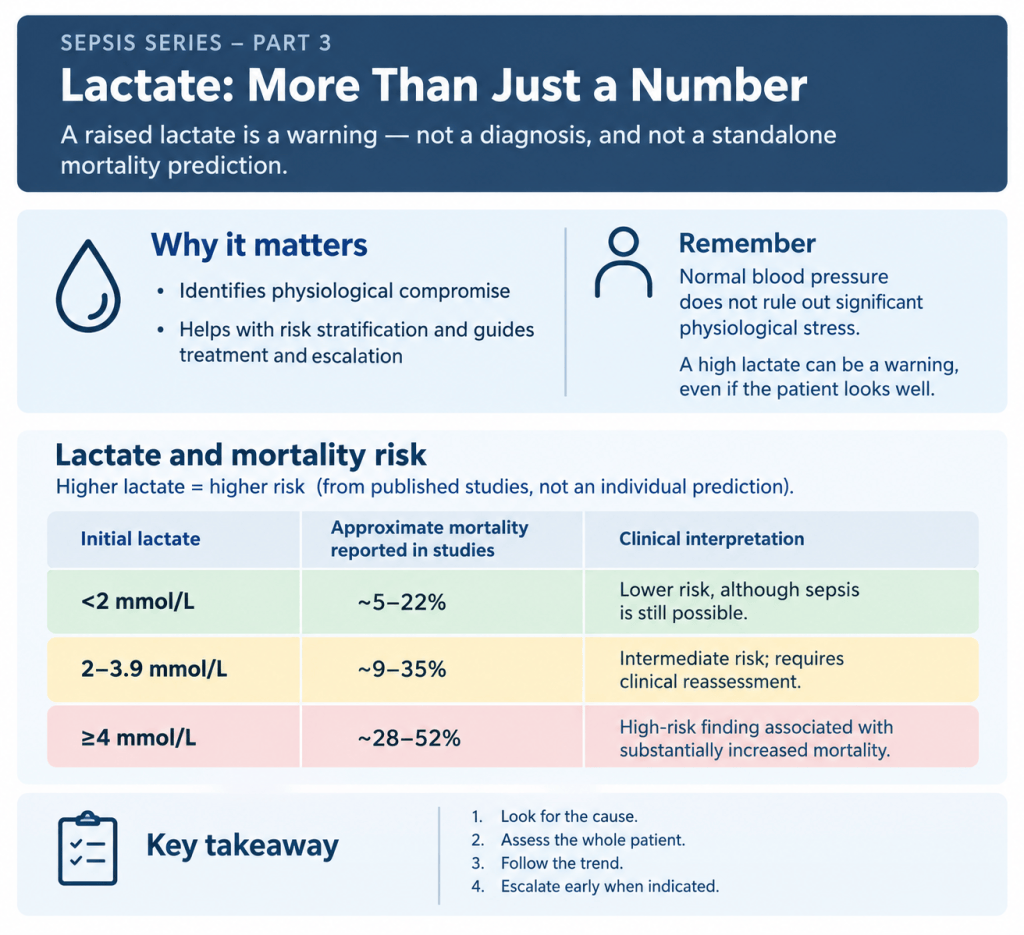
Lactate also provides important prognostic information. Across studies of patients with infection and sepsis, mortality generally increases as the initial lactate concentration rises.
| Initial lactate | Approximate mortality reported in studies | Clinical interpretation |
|---|---|---|
| <2 mmol/L | ~5–22% | Lower risk, although sepsis is still possible |
| 2–3.9 mmol/L | ~9–35% | Intermediate risk; requires clinical reassessment |
| ≥4 mmol/L | ~28–52% | High-risk finding associated with substantially increased mortality |
These ranges reflect different study populations and clinical settings; they are not an individual’s predicted probability of death. Nevertheless, the association between higher lactate and mortality is an important warning. A lactate of ≥4 mmol/L should raise significant concern, even if the patient remains normotensive.
Lactate alone does not diagnose septic shock or determine prognosis. The overall clinical picture, organ dysfunction and response to treatment remain essential.
The trend matters
A single lactate provides a snapshot of the patient’s physiological state. Serial measurements, when clinically indicated, can help assess the patient’s trajectory.
A persistently elevated or rising lactate despite appropriate treatment should prompt us to reconsider whether the underlying problem has been adequately addressed. Is there ongoing infection? Is source control adequate? Could perfusion remain compromised?
Conversely, a falling lactate alongside clinical improvement is reassuring. However, an improving number must never override evidence of ongoing deterioration.
What should we do when lactate is high?
Do not simply document the result and move on.
- Look for the cause: assess for sepsis, hypoperfusion and other possible contributors.
- Reassess the whole patient: consider mental state, respiratory status, urine output, peripheral perfusion and organ dysfunction.
- Review the trend: repeat lactate when appropriate and assess the response to treatment.
- Escalate early: significant hyperlactataemia with suspected sepsis or physiological compromise warrants prompt senior review and consideration of higher-level monitoring, including HDU or ICU when indicated.
The final message
Lactate is more than a number to be checked, recorded and forgotten. It can help us recognise physiological compromise, identify patients at increased risk and assess whether they are responding to treatment.
When you see a significantly elevated lactate, don’t ask only:
“What is the number?”
Ask:
“What is the physiology telling me, and what do I need to do about it?”
Clinical Pearl
In sepsis, an elevated lactate is a warning—not a diagnosis or a standalone mortality prediction. Look for the cause, assess the whole patient, follow the trend and escalate early when indicated.
See the patient. Understand the physiology. Follow the trend. Act early.
References
- Evans L, Rhodes A, Alhazzani W, et al. Surviving Sepsis Campaign: International Guidelines for Management of Sepsis and Septic Shock 2021. Critical Care Medicine. 2021;49(11):e1063–e1143.
- Shapiro NI, Howell MD, Talmor D, et al. Serum lactate as a predictor of mortality in emergency department patients with infection. Annals of Emergency Medicine. 2005;45(5):524–528.
- Mikkelsen ME, Miltiades AN, Gaieski DF, et al. Serum lactate is associated with mortality in severe sepsis independent of organ failure and shock. Critical Care Medicine. 2009;37(5):1670–1677.
- Nguyen HB, Rivers EP, Knoblich BP, et al. Early lactate clearance is associated with improved outcome in severe sepsis and septic shock. Critical Care Medicine. 2004;32(8):1637–1642.
- Prescott H, Antonelli M, Alhazzani W, et al. Surviving Sepsis Campaign: International guidelines for management of sepsis and septic shock 2026. Crit Care Med. 2026 Mar. Forthcoming. doi.org/10.1097/CCM.0000000000007075


Leave a Reply